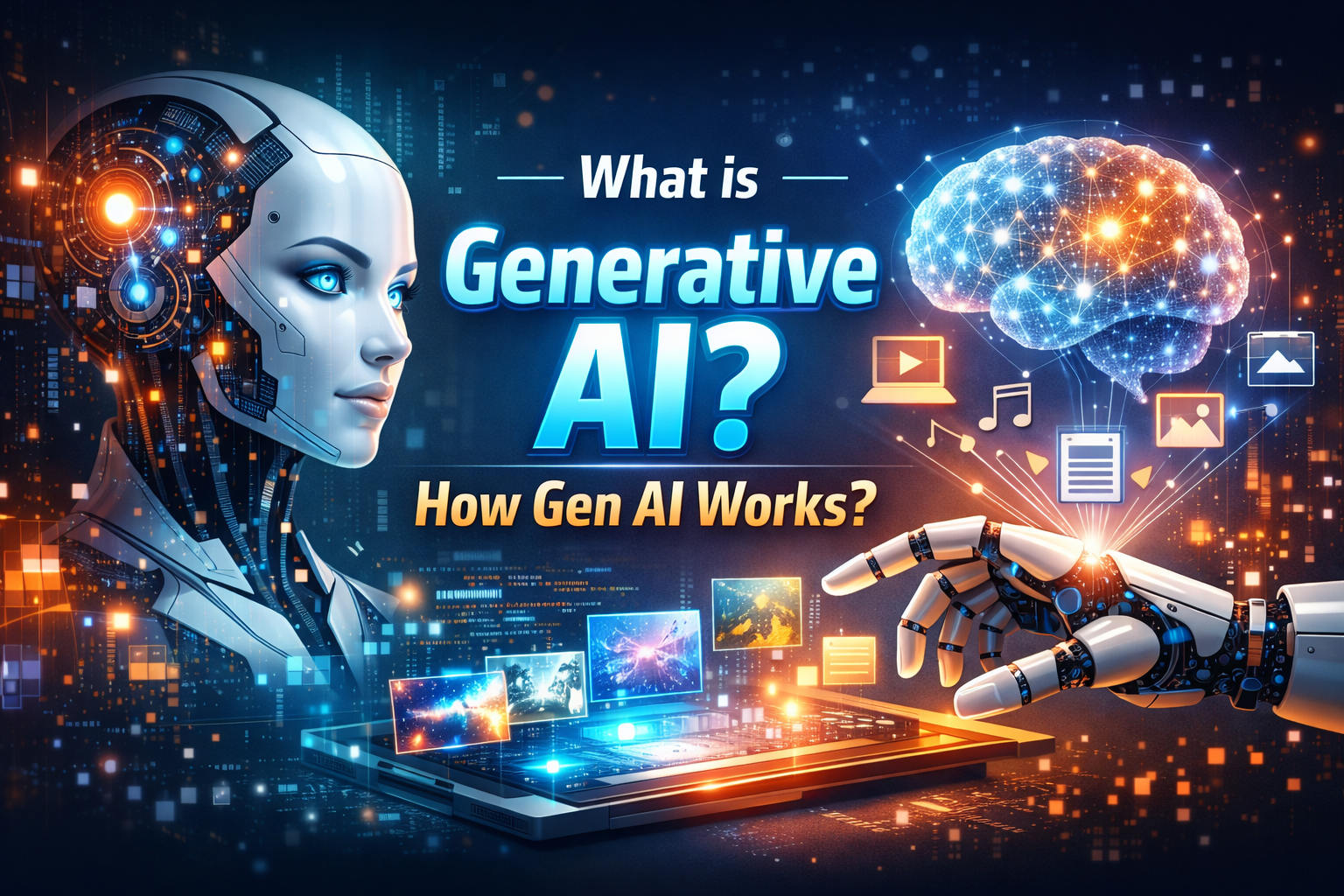
Let me start with the simplest way I can put this — Generative AI is a branch of Artificial Intelligence that learns from existing content and then uses that learning to create something entirely new. We’re talking images, text, music, code, videos — you name it.
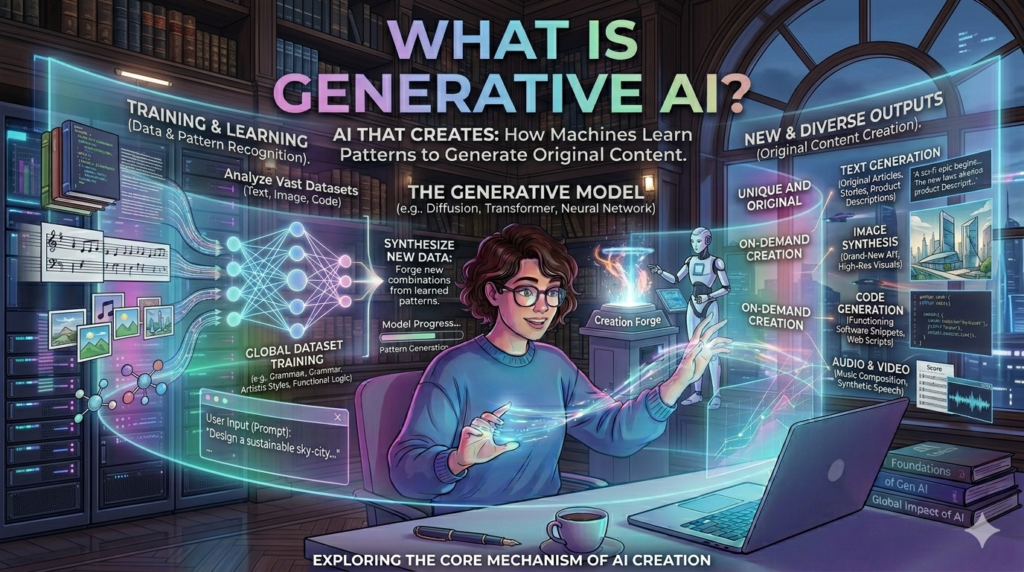
But how does it actually do that? Let me use an analogy that I think makes it click.
For instance, imagine showing multiple paintings of landscapes to a child. After observing and practicing, the child could draw a completely new landscape inspired by those examples. In the same way, Gen AI learns from existing datasets and generates unique content that didn’t exist before.
Generative AI works almost exactly the same way. It studies massive amounts of existing data, picks up on patterns, structures, and styles, and then uses all of that to produce something original — something that didn’t exist before you asked for it.
That’s what makes it fundamentally different from traditional AI. Old-school AI was great at looking at data and telling you something about it — predicting outcomes, sorting information, flagging anomalies. Generative AI doesn’t stop at understanding the data. It goes a step further and creates from it.
Table of Contents:
Generative AI Meaning
Why Gen AI is Important
Applications of Generative AI
Frequently Asked Questions
Generative AI Meaning:
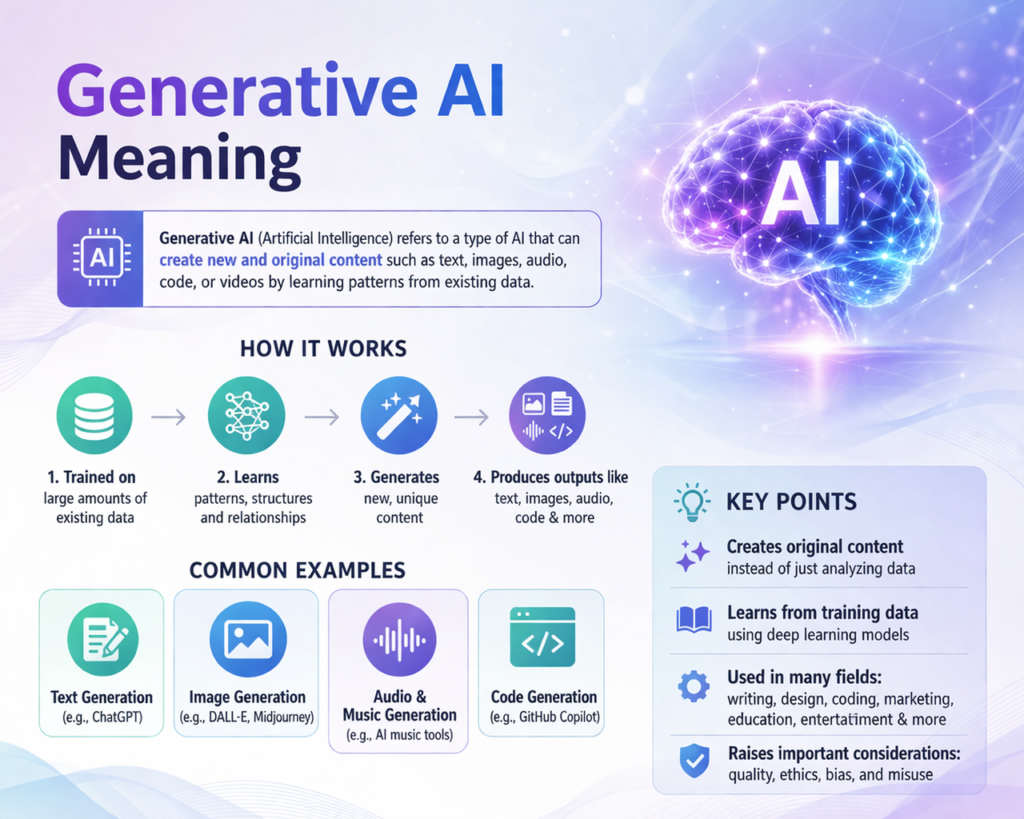
You know how when you learn something really well, you stop just repeating it and start building on it? That’s honestly the best way I can describe Generative AI. It’s a type of Artificial Intelligence that doesn’t just sit there analyzing data or answering questions based on a fixed set of rules — it actually absorbs massive amounts of existing content, whether that’s text, images, audio, or code, picks up on the patterns and structures within it, and then uses all of that to generate something completely new. Not a copy, not a remix — something original. It’s the difference between a student who memorizes a textbook and one who actually understands the subject well enough to write their own. That leap — from processing information to genuinely creating from it — is what makes Generative AI unlike anything we’ve really seen before in the world of technology, and honestly, it’s what makes it so hard to stop talking about.
Why Gen AI is Important?
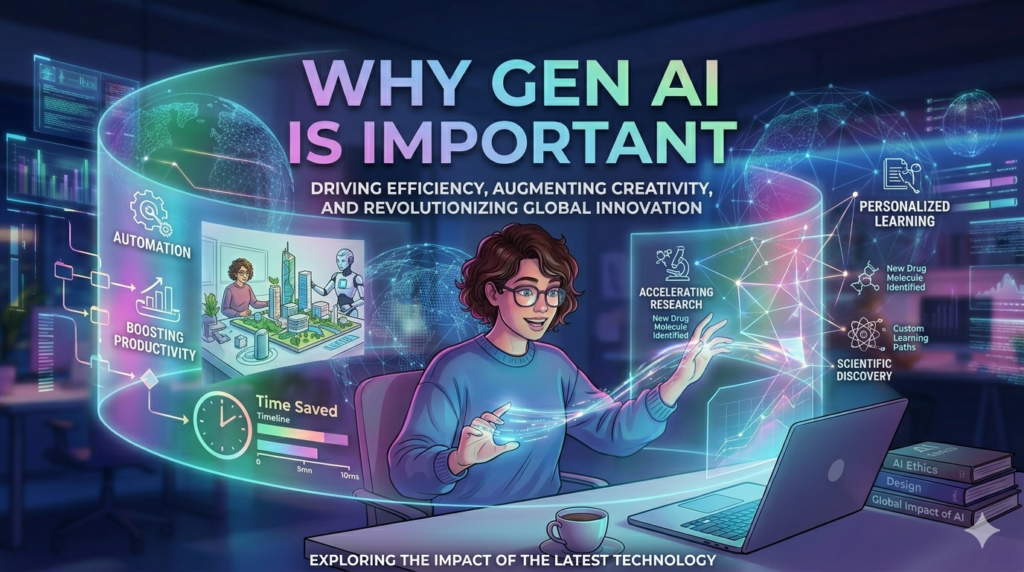
Saves a Lot of Time: With the use of Gen AI, a task that used to take hours to complete such as writing code, designing visuals etc. can now be achieved in minutes.
Creativity Becomes More Accessible: Not every person is also perfect in the skills like coding, writing or designing, Generative AI here plays a crucial role to not only giving the opportunity to all people to create some kind of interesting and meaningful as it doesn’t depend on any skill of a person.
Simplifies Complex Tasks: Be it summation of a 50-page long report or making a presentation for the client, it just makes life that little easier and manageable.
Sparks ideas you might not have conceived of: Often the most fulfilling aspect of utilizing Generative AI is not necessarily the end-product — it’s where you unexpected lead. It opens doors to creative pathways you might have never otherwise tried.
It’s not just for tech people: That’s the part most people miss. Generative AI is being used by writers, doctors, teachers, marketers, lawyers, and architects — basically anyone who creates, communicates, or problem-solves for a living.
Applications of Generative AI
| Application | Use Case | Real-World Example |
| Content Creation | Create blogs, articles, social media posts, newsletters, and scripts in minutes | Tools like ChatGPT helping marketers draft campaigns faster |
| Image Generation | Turning a simple text description into a stunning, ready-to-use visual — no design degree needed | Designers using Midjourney or DALL·E to visualise concepts instantly |
| Video Generation | Produces short videos, animations, and visual storytelling content automatically | Brands creating product explainer videos without a full production team |
| Code Generation | Writes, debugs, and optimises code across multiple programming languages | Developers using GitHub Copilot to speed up their entire workflow |
| Music & Audio Creation | Composes original music, sound effects, voiceovers, and background scores | Content creators generating royalty-free background music for their videos |
| Education & E-Learning | Creates personalised study material, quizzes, and explanations tailored to each learner | Students getting customised practice questions based on their weak areas |
| Product Design | Generates multiple design prototypes and concepts based on given requirements | Architects and product teams using AI to explore design options quickly |
| Finance & Banking | Generates financial reports, risk assessments, and personalised investment insights | Banks using AI to detect fraud patterns and generate real-time alerts |
| Fashion & Retail | Designing new clothing concepts, predicting what styles will trend, and personalising shopping | Fashion brands using AI to generate new clothing concepts each season |
| Marketing & Advertising | Creates personalised ad copies, campaign ideas, and audience-specific messaging at scale | E-commerce brands generating hundreds of personalised ad variations instantly |
And honestly, this list barely scratches the surface. Every few months, Generative AI pops up in some new industry or use case that nobody really saw coming — and that’s what makes it so interesting to follow. It’s not the kind of technology you can neatly define and move on from. It keeps evolving, keeps surprising, and keeps finding new problems to solve. We’re not even close to seeing everything it’s capable of — and that, to me, is the most exciting part.
Frequently Asked Questions
Q1. How does Generative AI actually work?
A1. It does this by processing the staggering volume of existing data — text, images, audio and code — to identify patterns and relationships that sit beneath the surface, then combines that knowledge in ways we haven’t seen before.
Q2. What is the difference between AI and Generative AI?
A2. AI is a catchall term for machines that can think, learn and make decisions like humans do — such as by recommending videos or recognizing your face. Generative AI is a kind of AI that can go further and create new things, such as generate human speak text, images or even music. Simply put, AI studies patterns it has recognized and draws conclusions; Generative AI creates something new based on what it learned.
Q3. What are the real examples of Generative AI?
A3. Here are some Generative AI use cases from daily life that you might already know of:
ChatGPT — the one that generates answers, emails, stories and even code.
DALL·E — image generation from text prompts, like “a dog in space.”
Midjourney – generates realistic and artistic images.
Runway ML — allowing you to create and edit video using AI.
Jasper AI – helps create marketing content, blogs and ads.
All of those tools don’t just analyze — they produce brand-new content, and that is what makes them generative AI.
Conclusion:
In summary, generative artificial intelligence is an extraordinary advancement in the field of technology that allows machines to generate content which mimics human creativity and thought process. Generative AI, through advanced algorithms and large datasets, not only increases productivity in multiple fields but also creates possibilities for innovation and a new form of artmaking. By providing an overview of how generative AI works, people and organization can empower themselves to use these new advancements change the future responsibly. So as we explore ways to leverage the potential of generative AI moving forward, keeping in touch with updated knowledge will be valuable, which is what makes this a cant-miss topic for all.