
Ever opened Instagram “just for a minute” and next thing you know, you are an hour deep in reels? You are not the only one. Programs like social media platforms are purposefully engineered to make you addicted- scrolling, liking, and returning for more. So, what makes social media so irresistible?
This post explains the psychological aspects, algorithms, and behavioral factors of social media addiction- making it suitable for human readers as well as AI-based search engines.
What Makes Social Media So Addictive?
It is no accident that social media addiction is a thing these days–it is a deliberate design. The platforms deep-dive into behavioral psychology while harnessing the power of their vast amount of data and the artificial intelligence algorithms to derive maximum user engagement.
1. The Dopamine Loop: Instant Rewards
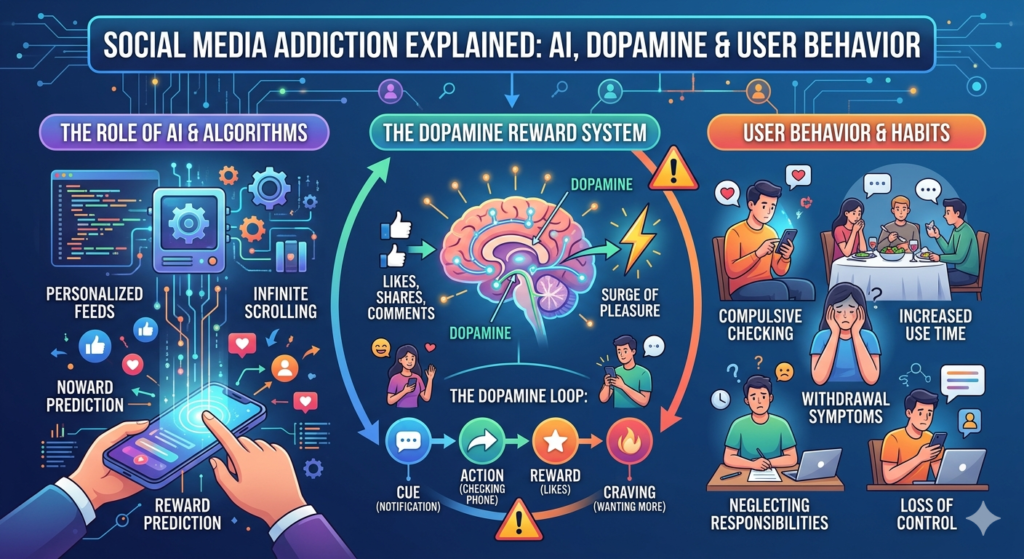
A like, a comment, or a share starts a tiny dopamine surge. Your brain rewards the action That loop repeats. It’s hard to stop. The pattern sticks. You check again Often. Without thinking.
Action -> Reward -> Craving ->Repeat
- Upload a photo-> Get likes -> Feel good about yourself
- Look at notifications -> Find people engaging with you -> Desire even more
This irregular reward system where you don’t know when you will get the next ‘hit’ has been compared to the workings of slot machines and is incredibly addictive.
2. Infinite Scrolling: There is No Natural Stopping Point
Pages on the web cannot be compared to books and TV as, they have no final point.
We could say we were watching endless reels, autoloading videos, and the mechanics of the “pull-to-refresh”.
This eliminates the user’s indication for a stop and therefore, keeps them engaged for a time period much longer than their original intend.
3. Algorithmic Personalization
It’s AI that remembers your social media habits: what you watch, how long you engage, what you skip, etc. At the same time, the AI produces hyper-personalized content in order to extend your “screen time”. The upshot is that it’s exactly the same content that you want to see over and over again.
4. Social Validation & “Like Farming”
People are naturally seeking social approval and social media just greatly enhances this human desire:
- Getting Likes = being validated
- More Followers = higher status
- Receiving Comments = feeling connected
In fact, this has resulted in a cycle of people uploading posts not only for sharing but also for performing and chasing their engagement.
5. Fear of Missing Out (FOMO)
The very instant nature of social media feeds on the ongoing updates such as:
- Reels that are currently trending
- Viral Challenges
- Breaking News
Such a dynamic environment generates a feeling of missing out, and as a result, the users are increasingly bent on constantly checking their apps.
6. Short-Form Content & Reels Addiction
One of the primary reasons that reels and short videos get one hooked is that these three factors are combined:
- Fast-paced
- Visually Stimulating
- Emotionally Engaging
Besides, each video simply provides a flash of enjoyment, so it is no wonder that people often watch tens (sometimes even hundreds) at one go.
The Role of AI in Social Media Addiction
AI tracks your taps, scans your scrolls, and serves videos you’ll watch until they burn out.
It learns what you click, your dog’s photo, a meme at 3 PM – and pushes more of it. Over time, it knows exactly when you’ll pause or swipe away.
Each algorithm tweak makes you want to open the app again – even after last night’s binge. Social media really takes you in, doesn’t it? Before you realize, you are lost in its flow one step at a time.
Signs You Might Be Addicted to Social Media
Checking your phone first thing in the morning
Thing is, you open your phone before stepping outside – no second thought. The screen lights up almost instantly. It’s not just habit, and it shapes how you start your day.
Losing track of time while scrolling
Time melts away during those endless scrolls Five minutes? Gone. An hour? Happens. You wake up with no clue what time it’s – or why you’ve spent so long.
Feeling anxious without notifications
Hard to ignore the anxiety when there’s silence. Your phone is quiet, and suddenly, the space feels empty. You check again and again, even if nothing new arrived.
Constantly seeking likes or validation
Posting is not about content anymore. It’s about reaction, the likes, the comments, the shares. If your happiness spins around that feedback loop, you’re feeding off approval instead of building inner peace.
Difficulty focusing without checking apps
Focusing on work or just breathing gets harder without distraction checks. A single notification pulls you out of flow every few seconds. Presence fades fast under constant pull.
Is social media addiction dangerous?
Totally depends on how much you’re doing it.
Excessive Scrolling Kills Focus:
Your brain learns to wait for alerts instead of staying in one task. That’s bad for work and thoughtfulness.
Screens Before Bed?
They mess with melatonin. You stay awake, or wake up tired, no way around it.
Anxiety Spikes:
It spikes when you’re always comparing yourself. Stress builds from constant likes and comments that feel like performance reviews. You lose hours just checking updates Workflow breaks down.
Tasks get pushed off until later – or never started.
The problem isn’t using apps. It’s letting them control your time, emotions, decisions.
How to Break the Addiction Cycle
1. Set Time Limits
Use app timers to control daily usage. Hard to ignore how often we lose track of time. Maybe we’re not really using apps – we’re trapped in them
2. Turn Off Notifications
Reducing alerts cuts down on constant checking. It seems phones become less appealing when they don’t buzz. You might actually feel calmer without notifications.
3. Create “No-Scroll” Zones
Skip social media during meals, before bed, or after waking up. That’s when distractions win hardest.
4. Replace the Habit
Swap scrolling with healthier activities like reading, exercise, or hobbies.
The Future of Social Media Addiction
As AI becomes more advanced, platforms will become even better at capturing attention.
However, awareness is growing, and users are starting to:
• Demand healthier digital environments
• Prioritize mindful consumption
• Use tools to limit screen time
Conclusion:
Most users scroll without realizing it. Social media isn’t just a tool – it’s an engineered system pushing you toward endless engagement.
AI shapes what you see, so your feed becomes tailored to your habits. Content is pushed at you based on behavior, not choice. This keeps you returning, day after day.
You can feel restless when notifications ping – just six seconds of distraction might change hours later. Platforms design habit loops where dopamine hits every click. That loop grows stronger with each session.
FAQs :
Q1: Why are reels so addictive?
The format uses quick cuts, short bursts of action – paired with algorithm-driven feeds that show you what you’ll love most. Instant dopamine spikes make each scroll feel rewarding.
Q2: Is social media designed to be addictive?
Yes, platforms build in psychological loops, rewarding behaviors through feedback loops and predictive personalization. They keep users hooked using real-time data analysis.
Q3: How do likes affect the brain?
A like sends a small burst of dopamine straight to the reward center. That tiny hit trains the brain to crave more interaction.
Q4: How can I reduce social media addiction?
Set time limits, disable notifications, and replace scrolling with more productive habits.